





A Short Overview of the Article
In this article, the fifth in the series of articles devoted to Everyday Power Automate Solutions for Dynamics 365, we will build a simple flow that automatically checks for missing fields and sends a reminder whenever attention is required.
A Short Reference About the Author
Andrei is a well-skilled Project Manager leading a team of experts specializing in Microsoft technologies, including Dynamics 365, Power Platform, Azure, Copilot, and other Microsoft solutions. In addition to his leadership role, Andrei brings extensive hands-on experience in implementing Dynamics 365 Sales and Dynamics 365 Customer Service, combining strategic oversight with deep technical expertise.
Introduction
Every sales team relies on accurate opportunity data to track progress, build reliable forecasts, and make informed business decisions. Opportunity records require fields that can be validated and customized. They are commonly managed through business rules and Power Platform automation. However, not every Dynamics 365 implementation marks all important fields as required. In many projects, fields such as “Estimated Revenue”, “Estimated Close Date”, or “Budget Amount” remain optional because they are not always known when an opportunity is first created. This gives users more flexibility, but it also means that important information can easily be forgotten.
As opportunities move through the sales process, these fields become increasingly valuable. Missing information can make reports less accurate and harder for managers to understand the true state of the sales pipeline. Rather than asking managers to manually review every opportunity, we can use Power Automate to notify the manager or opportunity owner to review only the affected opportunities and complete any missing information at the right time.
Requirement
In the previous article from this series, Reminding about an Overdue Opportunity to Close Dates in Dynamics 365 CRM, we looked at a plain and clear way to satisfy the client's request. We learnt how to build a simple Power Automate flow that automatically reminds opportunity owners whenever an open opportunity has passed its expected close date. Now, let us look at another request that came directly from a sales manager.
During one of our meetings, the manager explained that some opportunities were being created with only the minimum amount of information. This was expected during the early stages of the sales process, but even after several days, some opportunities still had important business fields left empty. As a result, pipeline reports were missing the key information, and managers had to spend additional time reminding sales representatives to update their records.
The requested solution was straightforward. Once a day, the system should review all active opportunities and check whether the required business fields have been completed. If one or more of these fields are still empty and the opportunity was created 3 or more days ago, the manager should receive an email prompting them to review the record. This would help improve data quality without introducing additional validation rules that might interrupt the sales process.
Step-by-step Instructions
After you have accessed Power Automate and selected the correct environment, it is time to create the flow:
-
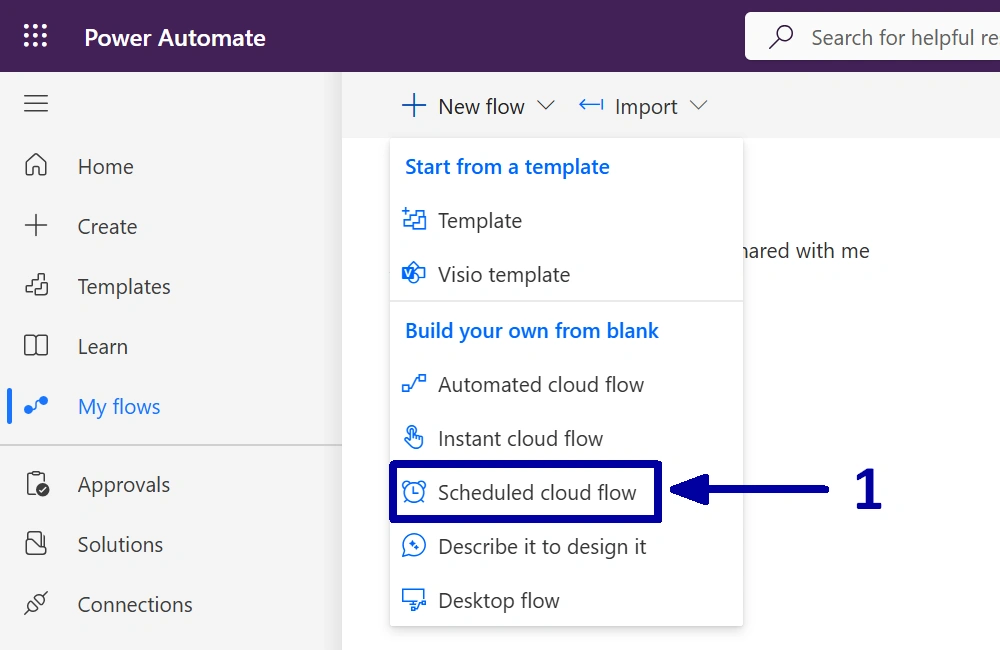
In the environment where you want to create the automation, start by creating a new "Scheduled cloud flow" (1).
-
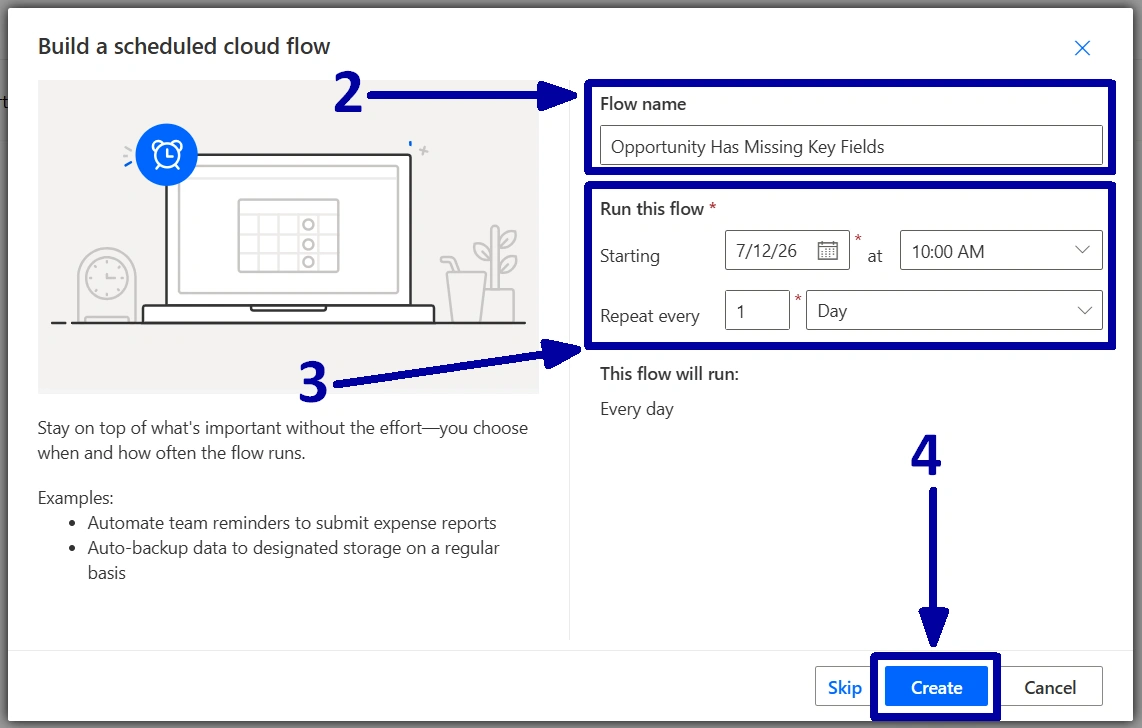
Give the flow a meaningful name (2), configure the start date, time, and recurrence interval (3), then click on the "Create" (4).
-
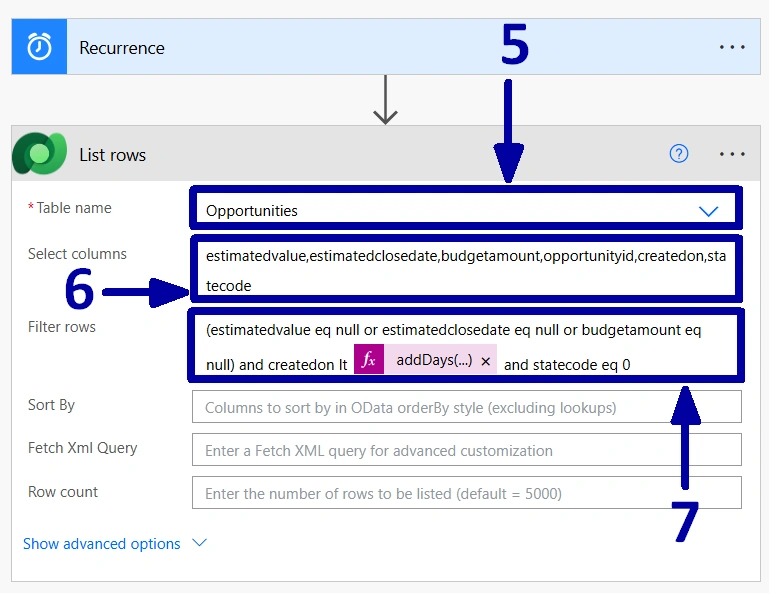
Before adding any actions, it is worth checking that the Recurrence trigger contains the schedule you configured in the previous step. Once that is confirmed, add a new "List rows" action. Since our goal is to monitor opportunities, select the "Opportunities" table in the "Table name" field (5).
Now, we do not need to retrieve every column from the "Opportunity table", so let us limit the results to only the fields we need. In the "Select columns" field, add only the "Estimated Revenue", "Estimated Close Date", "Budget Amount", "Opportunity", "CreatedOn", and "Status" columns (6). Retrieving only the required columns makes the flow slightly more efficient and easier to maintain.
And because we are checking whether the "Estimated Revenue", "Estimated Close Date", or "Budget Amount" is empty for an open opportunity, we also need to create a suitable filter (7).
-
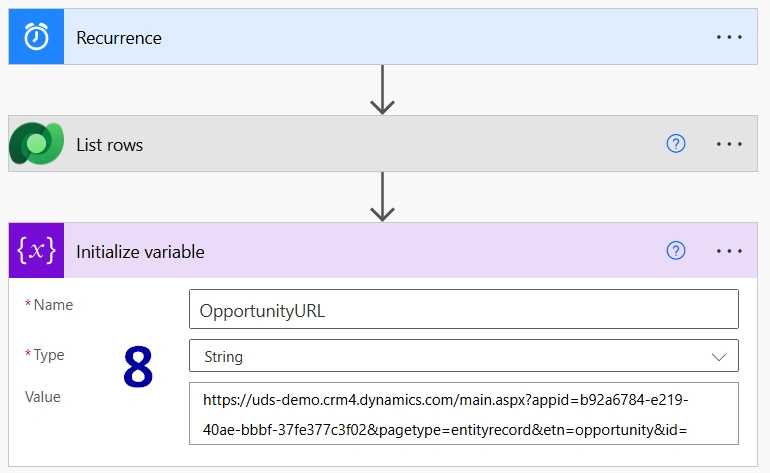
Next, let us create a variable to use in the email notification. This variable will contain a direct link to the opportunity record (8).
To build the record link, open any "Opportunity" in Dynamics 365 and copy the URL up to and including the last "=" character before the record "GUID". We will use this base URL to dynamically generate links to individual opportunity records.
-
Now, it is time to create an email notification. Add a new "Send an email" action, place the manager's email address in the "To" field, create a "Subject", and then build the message "Body".
In our example, we have included the opportunity's "Estimated Revenue", "Estimated Close Date", "Budget Amount", "CreatedOn", together with the "OpportunityURL" variable and the "Opportunity GUID". One small detail worth mentioning is that there is no space between the "OpportunityURL" variable and the "Opportunity GUID" value. This allows the email to generate a single clickable URL that opens the corresponding opportunity record directly.
! Note. We are intentionally not formatting the date or currency values in this example. Power Automate provides several ways to format both, but to keep this tutorial focused on the main idea, we will leave that as an exercise for you to explore.
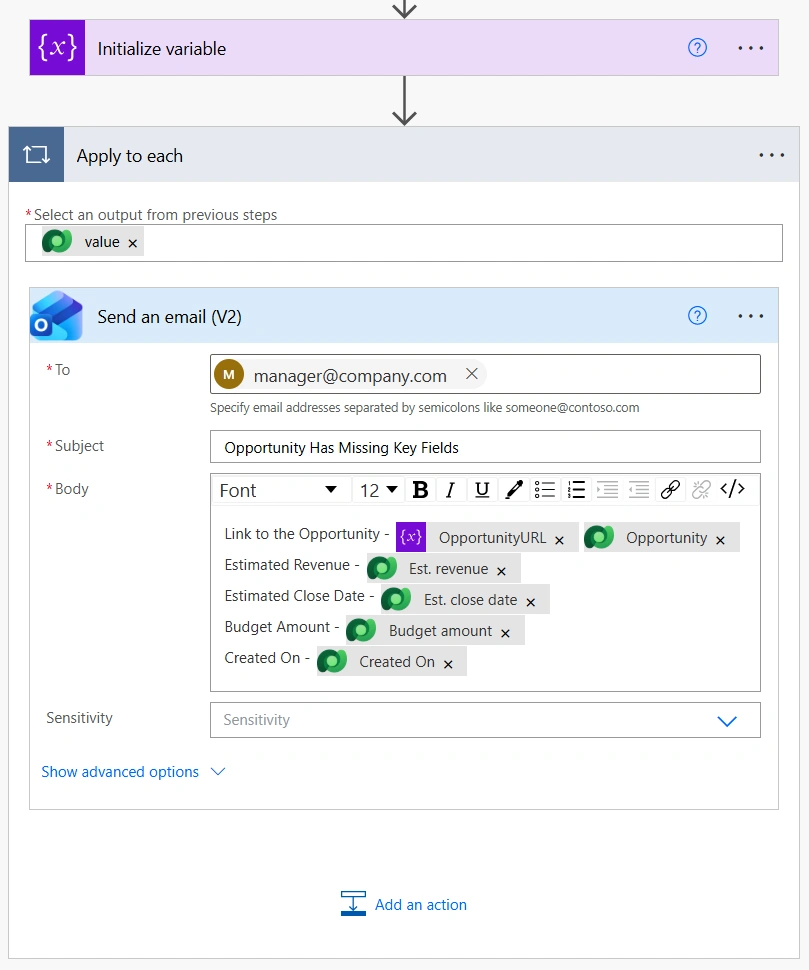
From this point on, the flow will run every day at 10:00 AM and notify the manager whenever an active opportunity is missing one or more of the key business fields.
Conclusion
Keeping opportunity records complete is just as important as keeping them up to date. While filling in every required field might seem like an easy solution, it is not always practical. In many businesses, some information simply is not available when an opportunity is first created. A gentle reminder at the right time allows sales teams to work more naturally while still ensuring that important data is eventually captured.
The flow we have built in this article is a simple example of how Power Automate can help improve data quality without adding unnecessary complexity to the sales process. You can easily adapt it to your own requirements by checking different fields, changing the reminder schedule, or sending notifications to the opportunity owner instead of the manager. Even a small automation like this can make a noticeable difference in the quality of your CRM data over time.
Frequently Asked Questions that May Interest You
Yes. Instead of sending the email to a fixed manager’s email address, you can dynamically retrieve the opportunity owner and use their email address in the “Send an email” action. This is useful when each sales representative is responsible for keeping their own opportunities up to date.
Absolutely. The flow can be adapted to check any fields that are important for your sales process. For example, you could also check fields such as “Probability”, “Customer Need”, “Decision Maker”, or “Next Step”. Simply update the columns retrieved by the “List rows” action and adjust the filter accordingly.
Yes. The Recurrence trigger can be configured to run daily, weekly, or according to another schedule that fits your business requirements. You can also adjust the time at which the flow runs. For example, you might choose to send reminders every weekday morning rather than every day.
Yes, but this requires some additional logic. You could add a field to the Opportunity table to store when a reminder was last sent and use that information to determine whether another notification should be generated. This allows you to control how frequently users are reminded and avoid sending the same notification every day.
In Dynamics 365 Opportunities, required fields must be completed before a record can be saved or moved through certain stages of the sales process. They are typically used to ensure that essential information is captured, such as the opportunity's name, customer, or other fields configured as mandatory by your organization.
Optional fields do not have to be completed to save or progress an Opportunity. They are used to capture additional information that may be useful for sales tracking, reporting, forecasting, or business processes but is not essential.
In short:
-
Required fields must be completed. Dynamics 365 may prevent the record from being saved or advanced until they contain a valid value.
-
Optional fields can be left blank and completed later if the information becomes available.
Administrators can customize which Opportunity fields are required, optional, or conditionally required based on business needs and process configuration.
This distinction helps companies balance data quality and process compliance with the flexibility for salespeople to create and update Opportunities efficiently.
-
Related Content
UDS Blog articles:
- Reminding about an Overdue Opportunity to Close Dates in Dynamics 365 CRM
- Detecting Duplicated Leads by Email in Dynamics 365 CRM
- Identifying and Automating Inactive Leads in Dynamics 365 CRM
- Managing Forgotten Leads in Dynamics 365 CRM
- Power Automate Solution: Instant Teams Notifications for New Contact Registrations