





A Short Overview of the Article
In this article, the third in the series of articles devoted to Everyday Power Automate Solutions for Dynamics 365, we will build a simple Power Automate flow that checks every newly created lead for an existing email address and notifies a manager when a potential duplicate is found.
A Short Reference About the Author
Andrei is a highly skilled Project Manager who leads a team with expertise in technologies such as Dynamics 365, Power Platform, Azure, Copilot, and more, delivering tailored solutions to meet each client's unique needs. He also brings extensive experience in implementing the Dynamics 365 Sales, Customer Service, and Marketing modules.
Introduction
Duplicated data is a common challenge in almost every CRM system. In many cases, users or customers unintentionally create duplicate records by entering existing data into the system. There are also situations in which leads are imported from external systems or backend processes, and the standard duplicate-detection rules are not triggered. As a result, duplicate records can enter the system without anyone noticing.
If your goal is to identify and clean up duplicate records in your environment, you may want to consider the UDS Duplicate Checker. It is a free-to-try add-on available from the Microsoft Marketplace that helps find and manage duplicates across your Dynamics 365 environment.
However, duplicate cleanup is only one part of the problem. Some businesses intentionally allow duplicate leads during the initial stages of communication and only need to identify them when a new record is created.
Requirement
Let us look at a real business scenario from an insurance project.
Customers could submit preliminary insurance requests via a web portal. Quite often, several members of the same family completed separate requests but used the same email address as their preferred contact method. Because this was expected behavior, the business decided not to enforce email uniqueness when new leads were created. Rejecting these requests would only make the application process more complicated for the legitimate customers.
However, once a lead moved beyond the initial inquiry stage, the email address had to be unique. To help the sales team identify these situations as early as possible, we were asked to create a simple automation.
Therefore, every time a new lead is created, the system checks whether another lead already exists with the same email address. If a match is found, the assigned manager receives a notification about the potential duplicate and can decide how to handle it before the lead progresses.
Step-by-step Instructions
Let us assume you already know how to access Power Automate and select the correct environment, skip the basics, and jump straight into the solution.
-
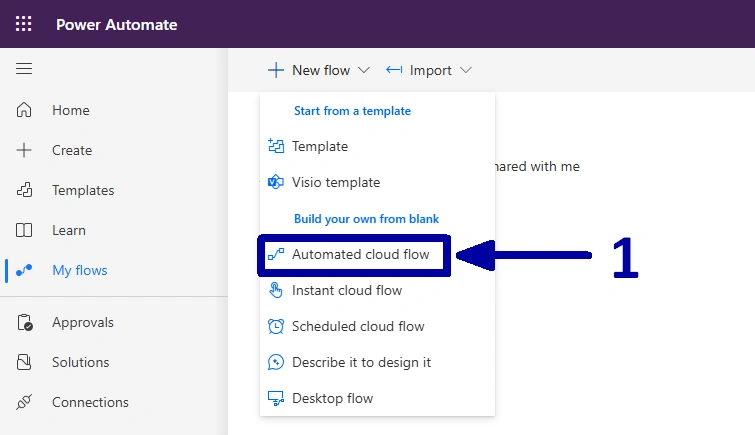
In the environment where you want to create the automation, start by creating a new “Automated cloud flow” (1).
-
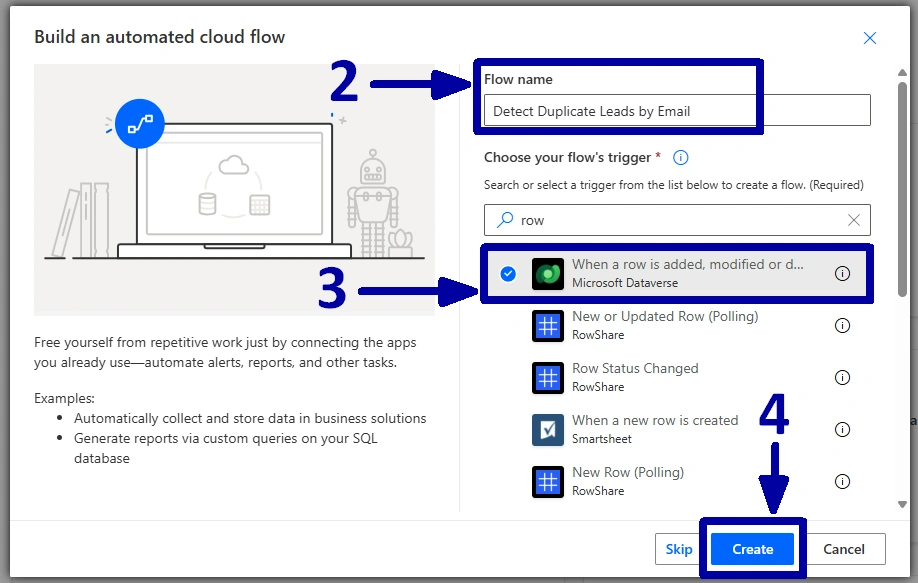
Give the flow a name (2), select the flow’s trigger. When a row is added, modified, or deleted (3), click on “Create” (4).
-
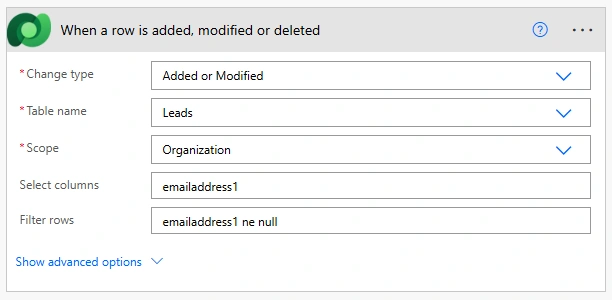
On the Power Automate designer page, adjust the trigger step in the following way:
1) Set the "Change type" for the "Added or Modified", because we want to monitor not only newly created Leads but also updates to existing ones.
2) Set the "Table name" to the "Leads", since we are working with the Leads table.
3) Set the "Scope" to the "Organization", because the flow should trigger the records created or modified by any user in the system.
4) Set the "Select column" to the "emailaddress1", because this is the schema name of the primary email field on the Lead table, and we only need to monitor changes to this field.
! Note. It is also recommended to set the "Filter rows" to the "emailaddress1 ne null", so the flow only triggers when an email address is actually present.
-
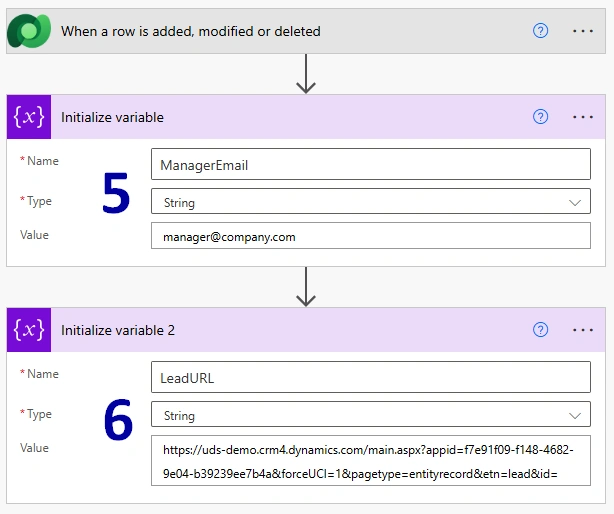
Next, let us create two variables to use later in the notification email. The first one will store the manager's email address (5). The second one will contain a direct link to the lead record (6).
! Note. To build the record link, open any "Lead" in Dynamics 365 and copy the URL up to and including the last "=" character before the record GUID. We will reuse this base URL to construct links for individual leads dynamically.
-
Add the next step to the "List rows". This step will let us find the existing leads with the same email address.
Go through the following stages:
1) Set the "Table name" to the "Leads", since we are searching within the "Leads table".
2) Set the "Select columns" to the "emailaddress1,leadid,createdon,statecode". This ensures that we only retrieve the fields needed for comparison and notification. You can leave this empty, but that would return the full record, which is unnecessary for this scenario and less efficient in general.
3) Set the "'Filter rows" to the "emailaddress1 eq <NewOrUpdatedLead_Email> and statecode eq 0 and leadid ne <NewOrUpdatedLead_GUID>”, since we are looking for an exact match among other active leads.
4) Set the "Sort by" to the "createdon asc". This is optional, but it helps keep the processing order consistent when multiple matches exist.
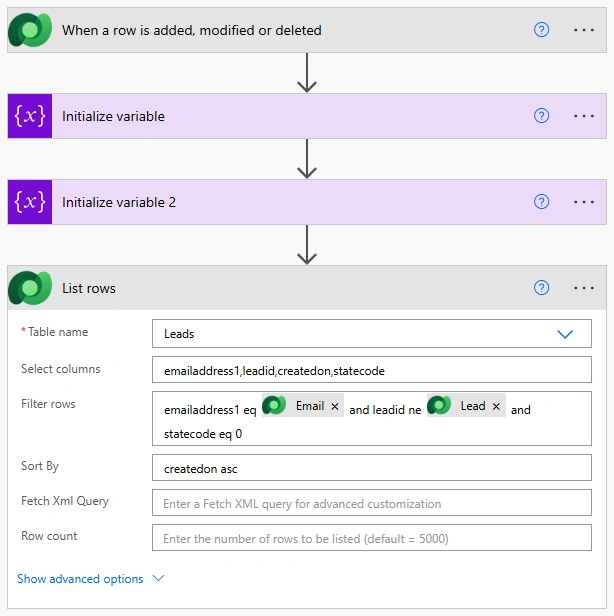
-
Now is the time to create an email notification. Add a new “Send an email” action, place the “managerEmail" variable in the "To" field, define a subject, and then build the message body.
! Note. Please, pay attention to the fact that there is no space between the “LeadURL” and the lead “GUID” in both cases. The only difference is that in the first case the “Lead” is taken from the trigger step, while in the second case it comes from the "List rows" step.
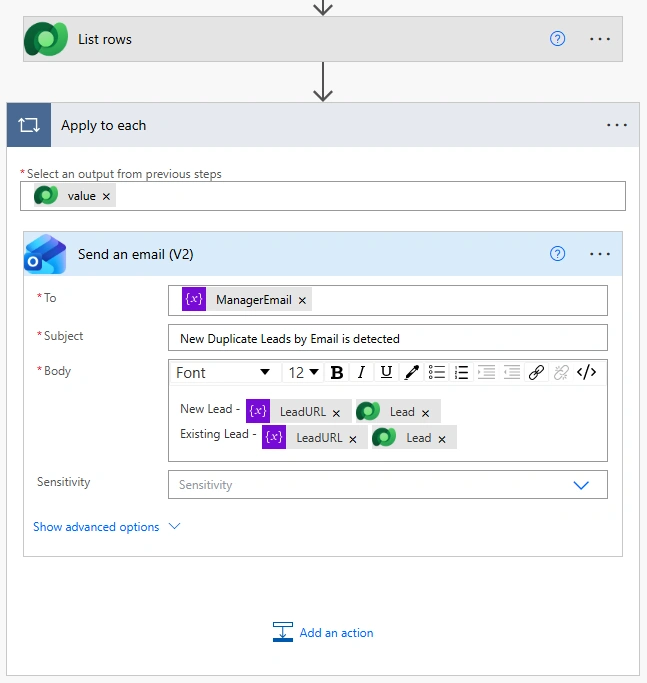
From now on, the manager will receive an email whenever a new lead is created with an existing email address, or whenever the email address of an active lead is updated to match another active lead's email address.
! Note. In this example, we created a very simple duplicate notification process. In a real-world scenario, you will most likely want to enhance it. For example, you can use string functions to convert email addresses to lowercase before comparing them, ensuring that the comparison is case-insensitive. You could also extend the process to detect and handle temporary ("10-minute") email domains.
Conclusion
Duplicate leads are not always the result of poor data quality. In some business scenarios, they are a natural part of the process and need to be handled rather than prevented. The important part is making sure they are identified early, before they affect the rest of the sales process. The solution we built in this article is intentionally simple. Still, it can save sales teams significant time by flagging potential duplicates as soon as they appear. From here, you can easily extend the flow to fit your own requirements, whether that means notifying different users, checking additional fields, or adding more advanced validation rules. Even in its basic form, this automation helps improve data quality while allowing your business process to remain flexible where needed.
Frequently Asked Questions that May Interest You
Dynamics 365 duplicate detection works well for many scenarios, but it may not cover every business requirement. For example, some companies intentionally allow duplicate leads during the initial stages of the sales process. A Power Automate flow provides more flexibility by notifying users about potential duplicates without preventing record creation.
No. This flow only checks for duplicates when a lead is created or when its email address is updated. If you need to identify existing duplicate records, you should perform a separate cleanup using Dynamics 365 duplicate detection or a dedicated solution such as the UDS Duplicate Checker.
Yes. You can modify the “List rows” filter to compare additional fields such as phone number, company name, or a combination of multiple fields. This allows you to tailor the duplicate detection logic to your organization's specific business rules.
For a production environment, consider normalizing email addresses before comparison (for example, converting them to lowercase), filtering out disposable email domains, adding conditions to avoid unnecessary notifications, and including additional information about the matching lead in the email. You could also extend the flow to create tasks, post notifications in Microsoft Teams, or route potential duplicates to a dedicated review queue.
Related Content
UDS Blog articles: