





A Short Overview of the Article
This article introduces the UDS Migration Calculator, a free add-on that helps companies estimate the cost and complexity of moving from Dynamics CRM on-premises to Dynamics 365 online. It explains how the calculator analyzes an existing CRM environment, including data volumes, custom entities, fields, plugins, workflows, reports, and active users, to produce a more reliable migration estimate based on actual system data.
The article also covers how the calculation works, how the tool handles errors in older or complex CRM environments, what information is included in the final report, and which migration costs are outside the estimate. Overall, it shows how the calculator can provide organizations with useful numbers for early migration planning, budgeting, and decision-making without requiring a full discovery workshop.
Explore the UDS Migration Calculator.
A Short Reference About the Author
Vlad is a skilled Dynamics 365 Consultant and Project Manager who leads complex projects and oversees key areas such as Microsoft licensing, solution configuration, data migration, and business process customization.
Introduction
Every conversation about moving from Dynamics CRM on-premises to Dynamics 365 online starts in the same place. Not with architecture, not with timelines - with a number. What is this going to cost us?
It is a fair question and a hard one to answer. Migration pricing depends on how much data you have, how far your system has drifted from out-of-the-box, and how many people depend on it every day. Most companies do not have those numbers written down anywhere. They have a rough sense that the CRM is "big" and "customized," which is not something anyone can put in a proposal.
The usual way to close that gap is a discovery workshop: a few calls, a few days of a consultant's time, a questionnaire nobody enjoys filling in. That works, but it is slow, and it happens before you have decided whether migration is even on the table this year.
The UDS Migration Calculator skips this step.
What the Migration Calculator is
The Migration Calculator is a free add-on that runs inside your CRM, measures what is in it, and provides a migration price estimate. It is built for companies running Microsoft Dynamics CRM 2015, 2016, or Dynamics 365 on-premises who are considering the move to Dynamics 365 online.
It also runs in an online environment if you are planning a tenant-to-tenant move or want a data profile of your system.
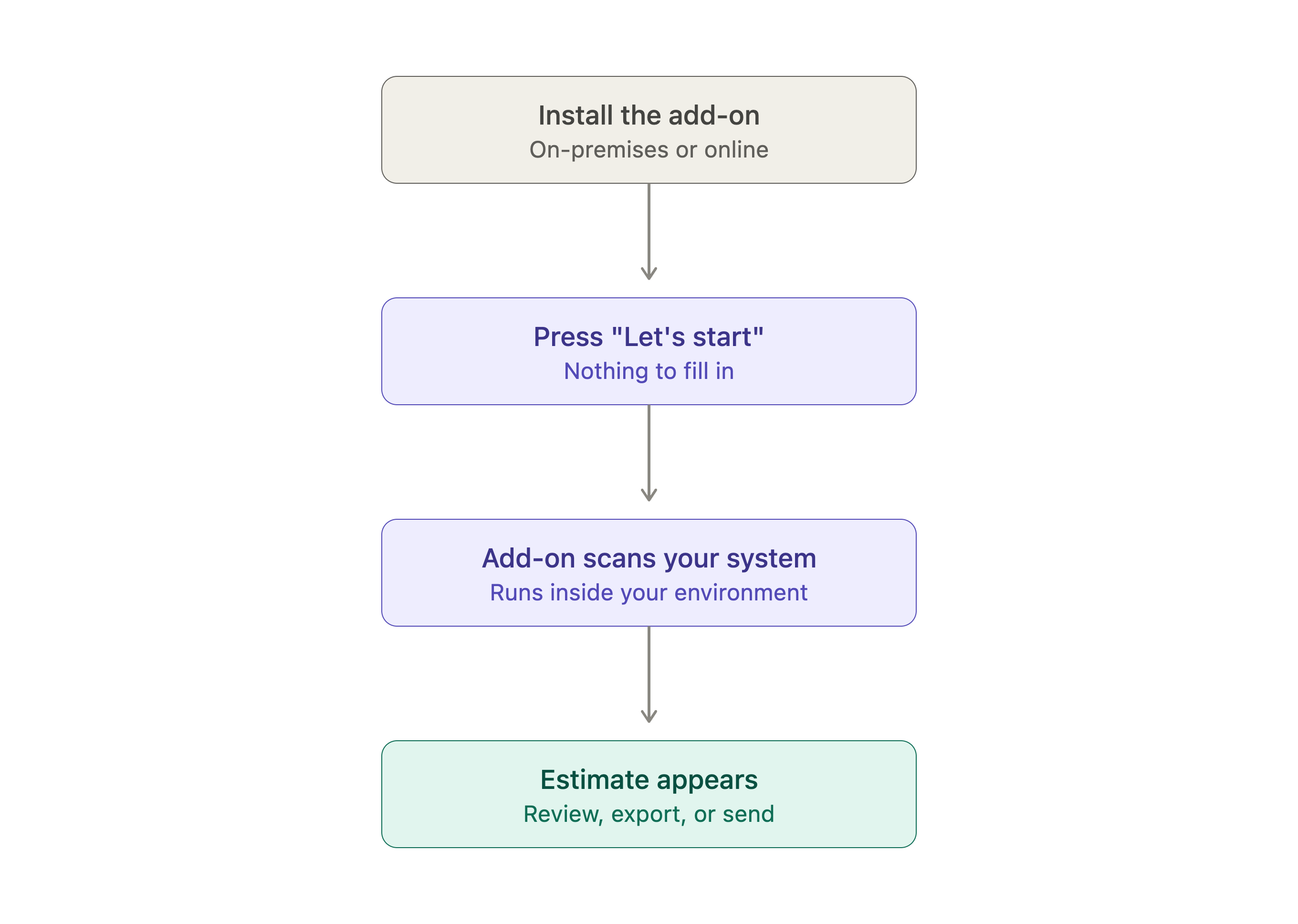
You install it, click on one button, and come back to the number.
Find the free UDS Migration Calculator on the Microsoft Marketplace.
Why it is More Reliable Than an Estimate on Paper
The important thing about the calculator is that nobody types anything in. No form asks you how many accounts you think you have.
Instead, the add-on reads your system directly through the Dynamics SDK. It pulls the full entity metadata, walks through every table, and counts the records in each one. It separates standard entities from custom ones, and it checks how many custom fields have been added to standard entities, which is usually where the real complexity of an old CRM hides.
Alongside the data volume, it inventories the customization layer: custom plugin assemblies, plugin steps, custom workflows, custom web resources, and reports. It reads your CRM version and counts your active users. All of that goes into the estimate.
That distinction matters. A system with 40 million records in three standard tables is a very different migration from a system with 4 million records spread across sixty custom entities, each one wired to a plugin. Both would probably be described as "we have a lot of data" in a discovery call. The calculator can tell them apart.
How the Calculation Runs
Only the aggregated metrics leave your environment: table names, record counts, customization counts, user counts. No record content, no customer data, no field values. The app tells you this on screen before it starts.
Because the process moves entity by entity, you can watch it happen. A progress bar fills tables are processed, and a live grid shows each entity's display name, system name, and record count as the numbers come back. On a large system, this takes upwards of ten minutes, then the app says so up front, so you can start it and go do something else.
When Something Goes Wrong
This is the part that separates a demo tool from something you can actually use on a twelve-year-old production CRM.
Old systems have broken corners. An entity that no longer supports the message being called. A table so large that the query times out. A component left behind by an uninstalled solution. In an earlier version of the calculator, one of those would sink the whole run.
Now, errors are collected in their own tab as the calculation proceeds. Each failed entity is listed with the error returned, and you can choose to skip it or retry it. Everything that succeeded is kept. You can download the error log if you want to look into a specific table, and the calculation completes with the data it was able to gather.
This is a small design decision with a large practical effect: the tool finishes on messy systems, which are exactly the systems most likely to be migrating.
What You Get at the End
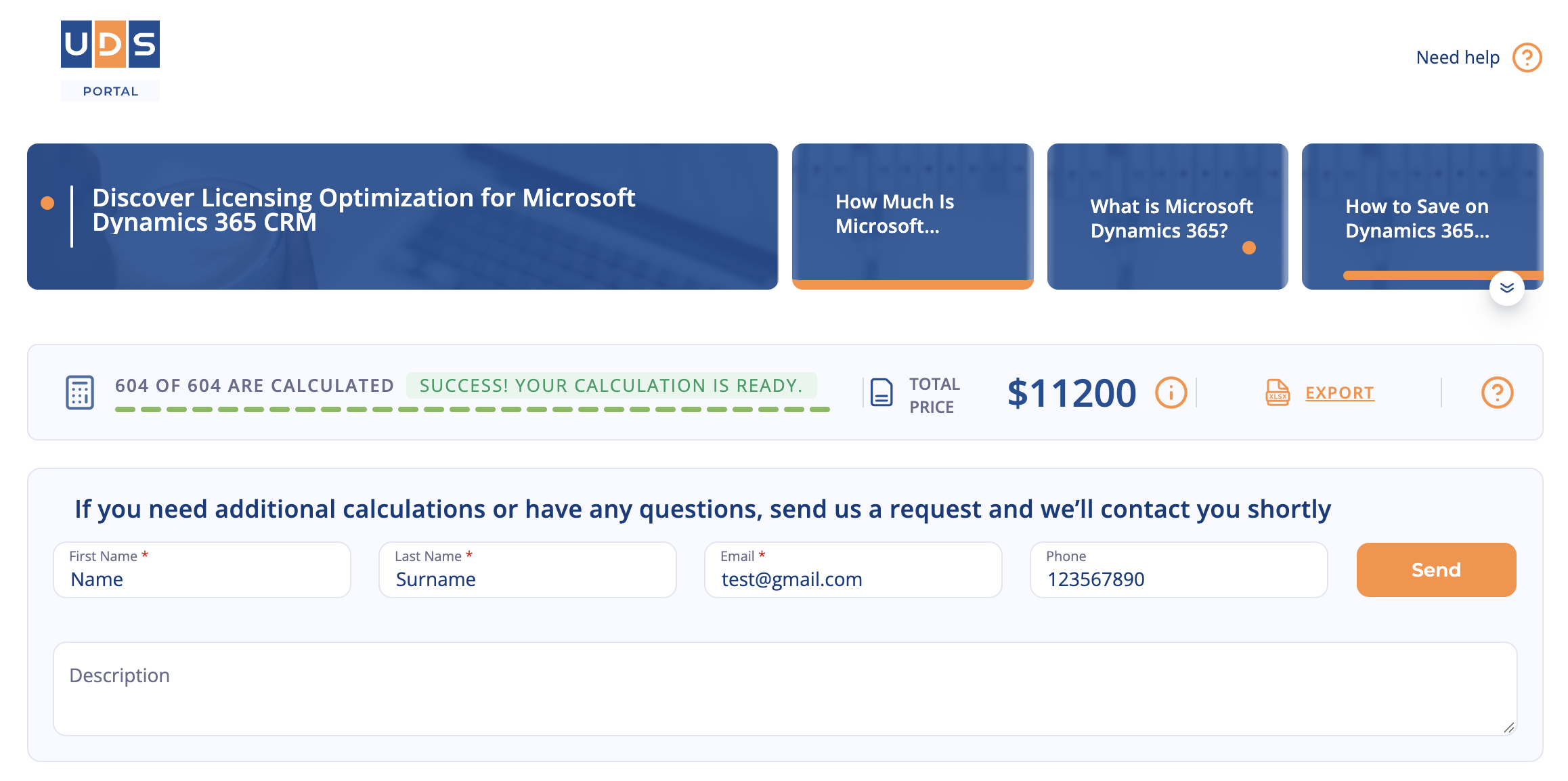
When the run completes, the price appears in the top ribbon, and the full breakdown stays on screen. From there, you can:
- Browse the entity table, which is searchable and paginated, so you can find any specific table and see its record count.
- Export the complete inventory to Excel, which is useful well beyond pricing. It is a data profile of your CRM, and a good starting point for deciding what to migrate and what to archive.
- Send the report to UDS as a short form with your contact details and attach the results to a request so a consultant can review your actual numbers rather than asking you to describe them.
What the Number Does and Does Not Cover
The price covers data migration: moving your records from the source system to Dynamics 365 online.
It does not include migrating business logic and customizations. Plugins, workflows, reports, and integrations that were written for an on-premises system usually need to be reworked rather than transferred, and that effort is scoped separately.
The estimate also excludes cloud storage, Dynamics 365 licenses, and any customization work in the target environment.
There is one more boundary worth knowing: above roughly 500 users or 100 million records, the figure becomes approximate. At that scale, migration strategy, staged cutover, delta loads, and archiving decisions, starts to influence cost more than raw volume does, and that needs a conversation.
When it Should Be Run
Run it if you are on Dynamics CRM 2015, 2016, or Dynamics 365 on-premises, and migration is on your roadmap this year or in three years. The output is useful even if you do nothing with it: a defensible record count, a customization inventory, and a cost range you can take to a budget discussion.
Run it also if you have been told your system is "too big to move." This claim is usually made without numbers to back it up. Ten minutes will tell you whether it is true.
Conclusion
Moving from Dynamics CRM on-premises to Dynamics 365 online does not have to begin with a lengthy discovery exercise or a guess based on incomplete information. The UDS Migration Calculator gives you a practical starting point: it looks at the system you have, measures its data and customization footprint, and turns those numbers into a migration cost estimate.
The result is more than a price. You get a clearer picture of your CRM's size, structure, and complexity, along with an inventory you can use for planning, budgeting, and deciding what should move to the cloud. And because the calculation runs inside your environment without reading record content, you can get that picture without handing over your CRM data.
It is not a replacement for a full migration assessment, and it does not attempt to price up the work of rebuilding customizations or designing the target environment. Its purpose is simpler: give you reliable numbers early, before a migration becomes a major project.
If Dynamics CRM on-premises is somewhere on your roadmap, the first step does not have to be a workshop. Run the calculator, see what is in your system, and start the migration conversation with numbers rather than assumptions.
Learn about our cloud migration services: https://uds.systems/services/cloud-migration/
Frequently Asked Questions that May Interest You
The estimate is always individual, as the cost depends on your current system, data volume, the presence and complexity of customizations, the number of integrations, requirements for the new system, etc. For a customized estimate, you can request a personal consultation with our Microsoft consultants.
For planning purposes, a Dynamics 365 CRM migration and implementation typically costs 20,000–100,000 euros for a small- to midsize business. However, simpler projects can cost less, and complex enterprise migrations can exceed 100,000 euros. Published implementation estimates vary depending on project scope and what services are included.
The cost of a Dynamics 365 migration depends on licensing, data complexity, customizations, integrations, implementation services, testing, and training.
Hidden costs include data cleansing, third-party tools, rebuilding legacy functionality, additional cloud resources, downtime, parallel system maintenance, ongoing support, and unexpected project delays.
To control costs, assess your existing systems, define a clear migration scope, prioritize essential features, and budget for both implementation and long-term maintenance.
For more detailed information, go to our Migration Calculator Add-on page.
Migrating everything "as-is" (lift-and-shift) is almost always cheaper and faster in the short term, but redesigning processes during migration (re-implementation) usually provides a lower total cost of ownership and higher ROI over the long term. Besides, keep in mind the following:
-
Choosing the right migration strategy
Lift-and-shift is often cheaper upfront, while re-implementation can reduce long-term costs and technical debt.
-
Migrating only essential data
Exclude obsolete records and unnecessary history to reduce migration effort and complexity.
-
Minimizing customizations
Prioritize standard Dynamics 365 functionality over custom development to lower implementation and maintenance costs.
-
Simplifying integrations
Eliminate redundant interfaces and reuse standard connectors to reduce development and support costs.
-
Cleaning data before migration
Fix duplicates and inconsistencies early to avoid costly errors and rework.
-
Automating migration and testing
Reuse migration templates and automate validation to reduce manual effort and project delays.
-
Planning the scope and cutover early
Define requirements, dependencies, and responsibilities upfront to prevent the scope creep and unexpected costs.
-
Naturally, the more data, the more complex, time-consuming, and expensive it becomes. Poor-quality data requires data cleansing and transformation, which optimizes data management but adds complexity to the overall process.
Related Content
UDS blog articles: