
HomeBlogHow to Effectively Improve Product Discovery: Connecting Customer Needs with Product Data
How to Effectively Improve Product Discovery: Connecting Customer Needs with Product Data

Calendar iconPublished:November 4, 2026

Time iconTime to read:5 min

How to Effectively Improve Product Discovery: Connecting Customer Needs with Product Data

Data management
Dynamics 365
AI

A Short Overview of the Article

This article explores how companies can make product discovery easier by connecting customers’ real-world needs with structured product information. It shows why traditional category-based search often falls short and how customers benefit from finding suitable products across multiple categories.

It explains why harmonized product information management is essential and outlines a practical starting point for companies looking to turn better product information management into a stronger customer experience and competitive advantage. It also shows how it affects product data quality, supports product data standardization and product data enrichment, improves omnichannel product visibility, and search experiences.

A Short Reference About the Author

Sebastian is an experienced Dynamics 365 Consultant and Solution Expert who actively represents our company in the Nordic Region, particularly in Finland. He successfully introduces our Solution for Wholesalers, Product Information Management, and other unique UDS solutions and services.

Introduction

Have you ever tried to find the right products for a job on a website or webshop and given up because the path to an answer was harder than the purchase itself?

The problem is rarely a lack of products. More often, product information and website logic do not reflect how customers think about a need. Categories follow internal product structures. Important facts sit in descriptions or PDFs. Filters cover only a fraction of the properties that determine whether a product is suitable.

This is where better product discovery becomes essential. By combining a product information management system with AI-powered product search, companies can connect customer needs with relevant products more effectively.

A well-designed product discovery experience allows customers to search using everyday language, explore products across categories, and compare alternatives based on the properties that matter to them.

A Simple Example of a Product Discovery Problem

Imagine you need to paint your garage door outside, and rain may arrive before you finish. You do not start with a supplier’s category tree. You start with a job to do and a concern: what do I need, and which products will work in these conditions?

The answer may involve several categories: exterior paint, primer, brushes or rollers, cleaner, protective equipment, and masking tape. A useful cross-category product search should find suitable products across those categories in one journey, then present the results in category tabs. The customer can move between categories without losing the original need or receiving one confusing mixed list.

The right choice depends on specific facts. The paint may need to suit the garage door material, be intended for outdoor use, and resist rain after a stated drying or curing time. The primer and tools must match the paint and surface. Masking tape has its own important differences, such as removal time, suitable usage temperature, and whether it is intended for outdoor use.

These answers often exist, but they are buried in text and expressed differently on each product page. Improving product data quality and standardizing product attributes makes this information easier to find, filter, and compare.

What Customers Want from a Better Product Discovery Experience

A better experience begins with the use case. Customers should be able to describe their task in everyday language, see relevant products from several categories, narrow the options using properties that matter within each category, and compare alternatives without opening page after page.

An effective product discovery experience should:

  • Start with a need, such as painting a garage door outside when rain may arrive

  • Show relevant products from several categories in one search, organized in category tabs

  • Interpret customer requirements through natural language product search

  • Apply attribute-based product filtering using category-specific properties

  • Support product comparisons using harmonized property names, values, and units

  • Explain meaningful product differences, such as rain resistance for paint or removal time for masking tape

This is a different way of organizing product discovery. It does not replace categories. It connects them through the customer’s task while keeping each category’s distinct product properties visible.

The Two Connected Problems: Product Data and Website Experience

The first problem is product information. Manufacturers and retailers often hold critical facts such as free text, images, PDFs, or supplier-specific descriptions. The same property can have different names, units, value formats, or levels of detail.

Without harmonization, searches cannot reliably filter or compare products across suppliers, and customers cannot tell whether two differently worded claims mean the same thing.

This is why product data standardization is important. A consistent product data model establishes how product properties are defined, structured, and maintained. Through Product Information Management (PIM), businesses can create and manage structured product data that supports more reliable search, filtering, and comparison.

The second problem is the website or webshop experience. Even when useful facts exist, the site may not expose them through need-based navigation, relevant filters, compatibility rules, or product comparison tools. The customer sees products but not a clear path to a suitable choice.

These problems reinforce each other. Weak product data limits what the website can do. A weak website makes even good product data hard for customers to use.

Why AI Alone Will Not Fix Product Discovery

AI can help interpret a natural-language request, identify the likely task and constraints, extract specifications from documents, suggest category mappings, and flag missing information.

For example, it can recognize that “I’m painting my garage door outside, and it might rain” points to outdoor suitability and rain-related requirements, then map those needs to the appropriate structured properties.

However, customer-facing search should not depend on asking a generative AI model to read product descriptions from scratch for every query. That can add delay and produce results that are difficult to explain or reproduce.

More importantly, AI cannot safely invent missing structures. If a product record does not state when paint can withstand rain, a fluent answer can still be wrong. Search needs to retrieve against verified product facts, with clear rules for suitability and exclusions.

The fast path is a well-designed product data model. AI can help interpret the query and prepare or enrich data, while the search service uses harmonized fields, controlled values, compatible units, and category rules to filter and rank products.

People still need to define which properties matter, establish acceptable values, and validate low-confidence or business-critical information. Product managers and domain experts remain responsible for the rules and the final customer promise.

What the Product Information Model Must Support

A useful product information model goes beyond a product name, category, description, and price. It should support:

  • Structured product data and clearly defined product attributes

  • Controlled values and compatible measurement units

  • Variant-specific product information

  • Consistent definitions for properties shared across categories

  • Category-specific attributes that support meaningful comparisons

  • Clear links between products and the use cases they serve

Properties that have the same meaning across categories, such as indoor or outdoor suitability, need consistent definitions. Other properties should remain specific to their categories, so customers can compare the differences that matter.

For the garage-door example, the model might capture the door material, indoor or outdoor use, surface preparation, coverage, drying and curing times, and the time before rain exposure for paint.

It might record compatible primers and tools, plus the masking tape’s removal time, usage temperature, and outdoor suitability.

The exact attributes vary by category, but they must be captured in comparable, customer-understandable forms. A strong product information model also improves product data quality by making missing, inconsistent, or incomplete information easier to identify and correct.

What the Website Must Do with That Information

Once the product information is structured, the website can use it to retrieve relevant products, apply category-specific filtering rules, and support meaningful comparisons.

An effective webshop should:

  • Show search results in category tabs

  • Apply category-specific filters

  • Exclude incompatible products

  • Explain why an item appears in the results

  • Let customers compare realistic alternatives side by side

  • Present relevant product properties in consistent formats

Cross-category product search is particularly valuable when a customer’s task involves several product types. Instead of requiring customers to understand the webshop's category structure, search connects their needs to the relevant products.

Product comparison tools then help customers evaluate alternatives within each category. The comparison should retain the category-specific information needed to make a confident decision while presenting relevant properties in a consistent format.

The goal is not to show every product as quickly as possible. It is to move the customer from a need to a confident decision with less searching, less reading, and fewer surprises.

Natural-language input makes the search easy to start. Structured product information makes the results fast, relevant, and comparable.

A Practical Starting Point: How to Improve Product Discovery on a Webshop

Companies do not need to remodel every product category at once. A practical approach to how to improve product discovery on a webshop is to start with one customer journey where search and comparison are difficult.

The next steps are to:

  • Map the customer's use case and identify the task customers want to complete

  • Identify all relevant product categories involved in that journey

  • List the shared and category-specific properties that determine product suitability

  • Assess whether those properties are structured, harmonized, complete, and comparable today

  • Define the product data model and standardization rules required to support reliable search

  • Improve natural-language search, attribute-based filtering, and product comparison tools

  • Test the complete product discovery experience using real customer needs and scenarios

This work exposes gaps in both product data and website functionality. It also creates a concrete scope for improvement: a clearly defined search journey, a dependable set of product facts, and a comparison experience customers can understand.

How to Harmonize Product Data Across Suppliers

A major challenge for manufacturers, distributors, and retailers is that suppliers often describe similar products in different ways.

One supplier might use a technical term, while another uses a commercial description. Measurements may be expressed in different units, and important attributes may be missing altogether.

To understand how to harmonize product data across suppliers, companies need a shared product data model that defines:

  • Standardized attribute names and definitions

  • Accepted values and formats

  • Consistent measurement units

  • Category-specific data requirements

  • Rules for mapping supplier terminology to standardized properties

  • Validation processes for missing, inconsistent, or unreliable information

Product Information Management provides a central foundation for managing these processes. AI can support data mapping, attribute extraction, classification, and identification of inconsistencies, while domain experts validate the results.

The outcome is structured product data that can be reused across supplier portals, PIM systems, webshops, search services, and business intelligence tools.

UDS Product Information Management Solution

To help companies centralize and manage product information more effectively, UDS Systems offers a configurable Product Information Management Solution for Microsoft Dynamics 365. The solution enables businesses to manage extensive product catalogs in one system, reducing manual work and errors while improving the accuracy and consistency of product information.

The UDS PIM solution supports key product management processes, including product categorization, attribute management, product lifecycle management, product variants, pricing, localization, and cross-selling and up-selling opportunities. Its flexible configuration allows companies to adapt product structures, attributes, workflows, and data management rules to their specific business requirements.

A consolidated product database simplifies the collection and maintenance of product specifications, documents, and lifecycle changes, ensuring that product descriptions, specifications, variants, and other essential attributes remain consistent across sales channels. Products can belong to multiple categories, inherit category-specific features, and share components and properties where relevant. This creates a structured foundation for managing complex product portfolios and supporting different sales channels.

The solution can also be integrated with other modules and ERP systems.

Explore the UDS Product Information Management solution.
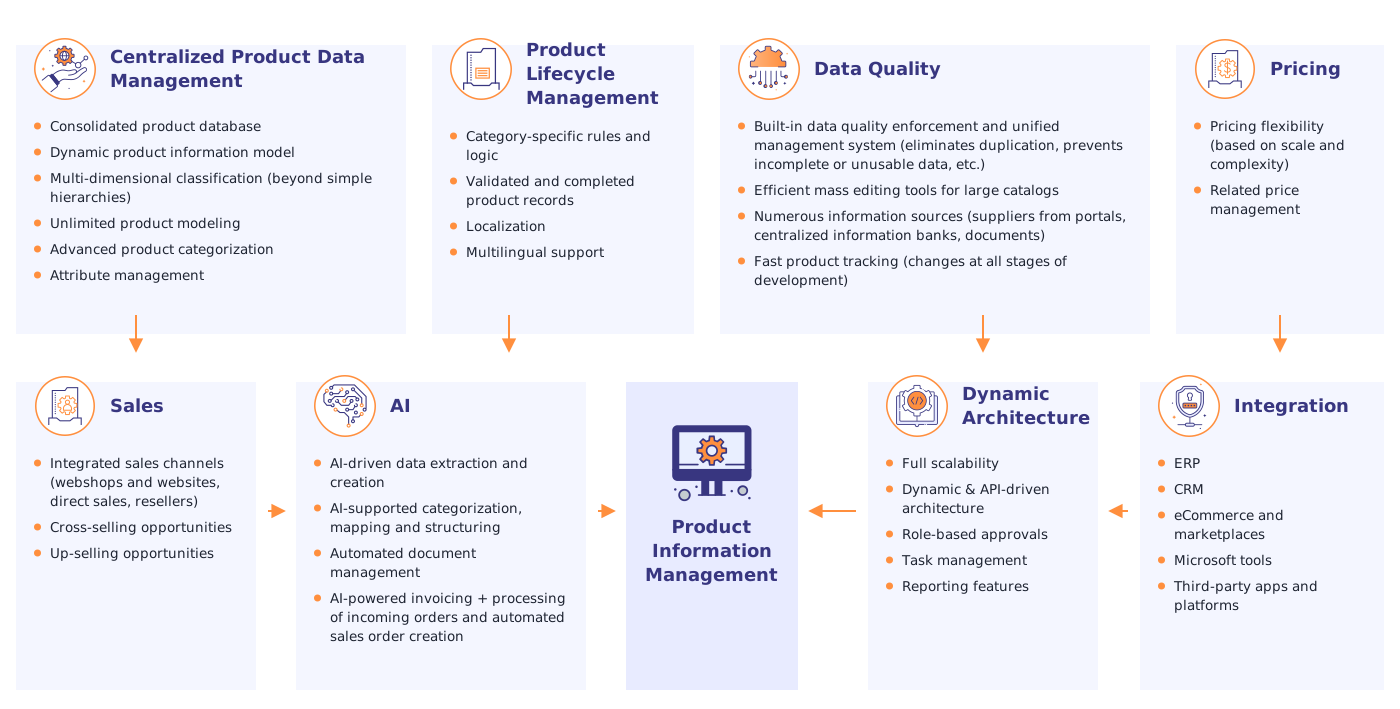
Product Discovery Schema

Why High-Quality Product Information Matters for Dynamics 365 Sales

High-quality product information is equally important for sales teams working with Microsoft Dynamics 365 Sales. By providing sales representatives with access to accurate, structured, and up-to-date product information through a centralized PIM system, companies can help them identify suitable products more quickly, respond reliably to customer questions, and prepare more relevant quotations.

For companies selling complex products or managing large product portfolios, this is particularly valuable. It applies to manufacturers, distributors, wholesalers, retailers, e-commerce companies, and other businesses that need to maintain consistent product information across multiple channels.

Explore our comprehensive Wholesale Solution.

Learn about the UDS Microsoft Dynamics 365 Sales Service.

Conclusion

Effective product discovery starts with understanding customer needs and connecting them with accurate, structured product information. By combining AI-powered natural language search, cross-category discovery, attribute-based filtering, and product comparison tools, businesses can help customers find suitable products and make informed purchasing decisions.

High-quality product data also supports internal processes. Integrating Product Information Management with Microsoft Dynamics 365 Sales gives sales teams access to consistent, up-to-date information, helping them respond to customer requirements and prepare relevant quotations more efficiently.

At UDS Systems, we connect the supplier portal, PIM, and webshop through a shared product data model, providing a consistent foundation for managing product information across the entire product lifecycle.

Book a free consultation to see how to improve your product discovery and project information management and simplify the process.

book a call

Frequently Asked Questions

Share